HISTORICAL DEVELOPMENT OF THE NOVÁ VČELNICE CASTLE
Formerly Nový Etynk
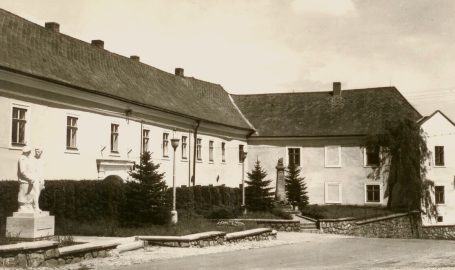
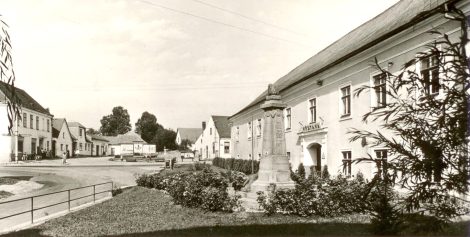
Originally a medieval fortress, the building was rebuilt during the Renaissance into a three-wing, single-storey castle. In the Baroque period it was further rebuilt and expanded with three additional wings surrounding a spacious courtyard.
The fortress was established at the turn of the 13th and 14th centuries.
The first owners of the fortress were the Knights of Včelnice, for example the knight Svatomír, who served in the army of King John of Luxembourg. After his death, his son Blaha became the holder of the fortress. In 1454 the small castle was jointly owned by Mikeš of Včelnice and Kuneš of Dubenka. During the wars between George of Poděbrady and the noble union, Včelnice was burned down in 1467 by Zdeněk of Šternberk during the rule of the Vojslavský family.
Not long after, in 1478, the fortress was acquired by the wealthy Kutná Hora burgher Václav Vencelík of Vrchoviště (who was knighted in 1492). Between 1467 and 1649 he had the fortress repaired and expanded. During his time a wing with a corner bay window of late Gothic style was built. By the end of the 16th century, the Vencelík family completed the castle in a four-wing Renaissance form (today only three wings remain preserved).
In 1649 the Vencelík family sold Včelnice.
The new owners, the Paradies de Lassaga family, carried out further modifications between 1693 and 1702. These included connecting the older castle with an arcade corridor and especially building the so-called “new castle” in the north-western neighborhood of the old fortress.
Further expansion did not take place until after 1796. The owner at that time was Dr. Josef Hillgardner, who was also knighted as Knight of Lilienborn. The new owner used the castle for his business and established a textile manufactory in the new complex. Only the entrance wing remained residential, while the perpendicular wings were significantly extended. Even in 1799 the construction had not yet been fully completed.
Between 1813 and 1814 the castle served as a field hospital for soldiers of Napoleon’s army.
Further modifications were made by the Viennese banker Johann Heinrich Geymüller, who had the castle rebuilt in the Empire style between 1839 and 1840 according to the design of the Jindřichův Hradec builder Josef Schaffer.
The right transverse wing of the new castle, which had been destroyed by fire, was partially demolished in the second half of the 19th century. In 1924 another owner, Richard Geymüller, rented the front wing of the building to Bohuslav Hrůza, who established a mechanical knitting workshop there and began operating it on October 15, 1924. Other rooms were modified and new spaces were created for private apartments.
In 1925 the western part of the castle building was rented to the mechanical locksmith Josef Zíka. He converted it into a workshop, storage space, and an apartment. In the same year, thanks to further modifications by the castle owner, twenty working-class families were provided with proper housing in neat apartments. In 1929 Bohuslav Hrůza bought part of the castle building and a barn.
After the Second World War in 1945 the property was nationalized and the local National Committee moved into the castle. Offices, apartments, and various facilities were located there. In April 1950 exterior renovations of the castle building began.
In 1954 a drinking water supply system and waste tanks were installed in the castle building.
The building was declared a protected cultural monument on May 3, 1958.
The National Committee remained in the castle for more than 40 years. Unfortunately, maintenance was neglected and due to the deteriorating condition the building was abandoned on August 1, 1987. On April 1, 1990 an independent municipal facility called “Castle Restaurant” began operating in the former school cafeteria located in the castle building.
In 1991 the castle was owned by Mr. Krýzl from České Budějovice (owner of the company 21st Century), who intended to build accommodation and recreational facilities with a capacity of 80 beds, but the project was unsuccessful.
In 1997 part of the castle was used as an auto repair workshop.
In 2003 a structural specialist was invited to assess the building and discovered serious damage to the outer walls near the wing adjacent to B. Smetana Street. This critical condition forced the town to carry out the necessary securing work in a minimal scope.
On September 29, 2004 the town council approved the sale of the castle to the Prague company HYPOKRASMED s.r.o.
The current owner of the castle is the company SaZ s.r.o., which purchased the castle in November 2019.